An approval belongs to the numbers it was given on
Every version of the business case is kept and fingerprinted, and each decision is recorded against the version it was made on. If anyone asks for changes, the requester uploads the revised case and the request starts again from the first step. Approvals given on the old version stay on the record and never carry over to the new one.
That can feel slower when the change was small. It is also what lets you say later that the CFO approved the figure in the version they read, say $1.4 million rather than the $1.2 million in the first draft, and show the document they had in front of them.
A typical route
- The requester’s manager approves. They are the one who knows whether the business needs it.
- Finance approves. They check the cost, the budget line and the classification. On Team and above, any one of the finance team can take it.
- The executives decide. As a quorum, such as any two of three (Business and above).
Steps run in order, so the executives only see a request Finance has already checked. Add the asset accountant or procurement as someone who receives a copy, and they get the approved document at the end without having to act on it.
Matching requests to your delegations
Unless the constitution says otherwise, section 198D of the Corporations Act lets a company’s directors delegate their powers, and spending authority is commonly delegated through a delegation of authority that says who can approve how much. Section 190 keeps the directors responsible for what a delegate does, unless they believed on reasonable grounds that the delegate would exercise the power in line with the duties the Act and the constitution place on directors, and, after proper inquiry where it was needed, that the delegate was reliable and competent. A record of who approved each request, at what amount, is how you show the delegation was followed.
Refrendo can apply your delegations by amount on Business and above. Save your CAPEX form as a template with the details the requester fills in, such as the amount, the cost centre and the asset class, and set each step to apply only when they call for it: the CFO over $250,000, the CEO over $1 million. The template designer draws the route as a flowchart, with the Yes and No paths laid out, so you can check it against your delegations before anyone uses it. Each detail can be written onto the form, and a step that was left out stays on the request with the reason, so the record shows why the CEO was or wasn’t asked.
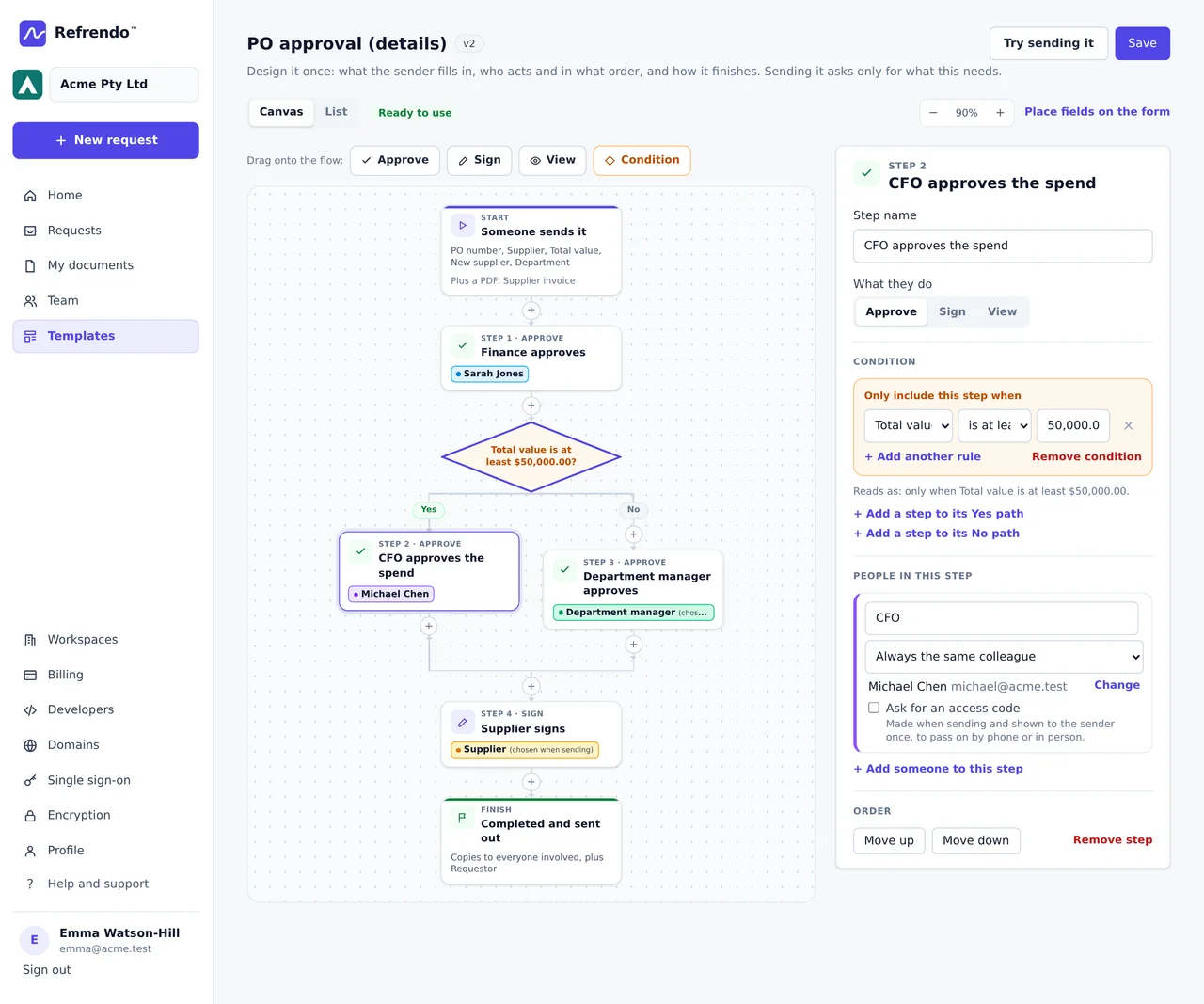
If your requests start in a finance or project system, that system can send them through the API on Business and above, with the details filled in. The supporting quotes can travel with the business case: a template can take up to ten supporting PDFs, joined after its own pages. Spending big enough to need the board itself can go as a circulating resolution, with the approved CAPEX request in the directors’ papers.
What the record shows later
Directors and officers have a duty of care and diligence under section 180 of the Corporations Act. The business judgment rule in section 180(2) protects a decision that was made in good faith and for a proper purpose, without a material personal interest, by someone who informed themselves about the subject to the extent they reasonably believed appropriate and rationally believed the decision was in the company’s best interests.
Refrendo cannot make a decision meet that test. What it can do is show who approved, in what order, when, and which version of the business case each of them saw. When an auditor or a board asks how a project was approved, the answer is one certificate.
When an approver is away
On Team and above, an approver can pass their turn to a colleague, or you can reassign it, and the record shows who was asked first. Pass it only to someone whose delegation covers the amount. Refrendo records the handover; it does not know your delegation limits.
This is general information, not legal advice. Directors’ duties and delegations depend on your constitution and circumstances. Check with your company secretary or lawyer before relying on a process for them.