Approved, then signed, then countersigned
A typical supplier agreement has three steps:
- Legal and Finance approve. Both have to approve, one after the other, or at the same time in one step. Team and above
- The supplier signs. Only once your side has approved the terms.
- Your director countersigns. Last, on the version the supplier signed.
Countersigning last means your director signs a document that has already been approved inside the business and already signed by the supplier, with nothing left to change. Once the agreement is sent, it can only change by going back to the first step. The supplier fills in only the fields you placed, and the certificate holds a SHA-256 fingerprint of the original document and the final one.
If an approver asks for changes, the request pauses with their comment. You revise the agreement and it starts again from the first step. Approvals given on the old version stay on the record against that version and never carry over to the new one.
An access code for the supplier, and your logo on the page
A signing link goes to an email address, and a supplier’s inbox is often shared. To make sure the person you spoke to is the one who opens it, ask for an access code for the supplier when you send. Refrendo makes a six-digit code and shows it to you once, or you choose one, and you give it to them by phone. They enter it before they see the agreement, and the certificate records that a code was entered, never the code.
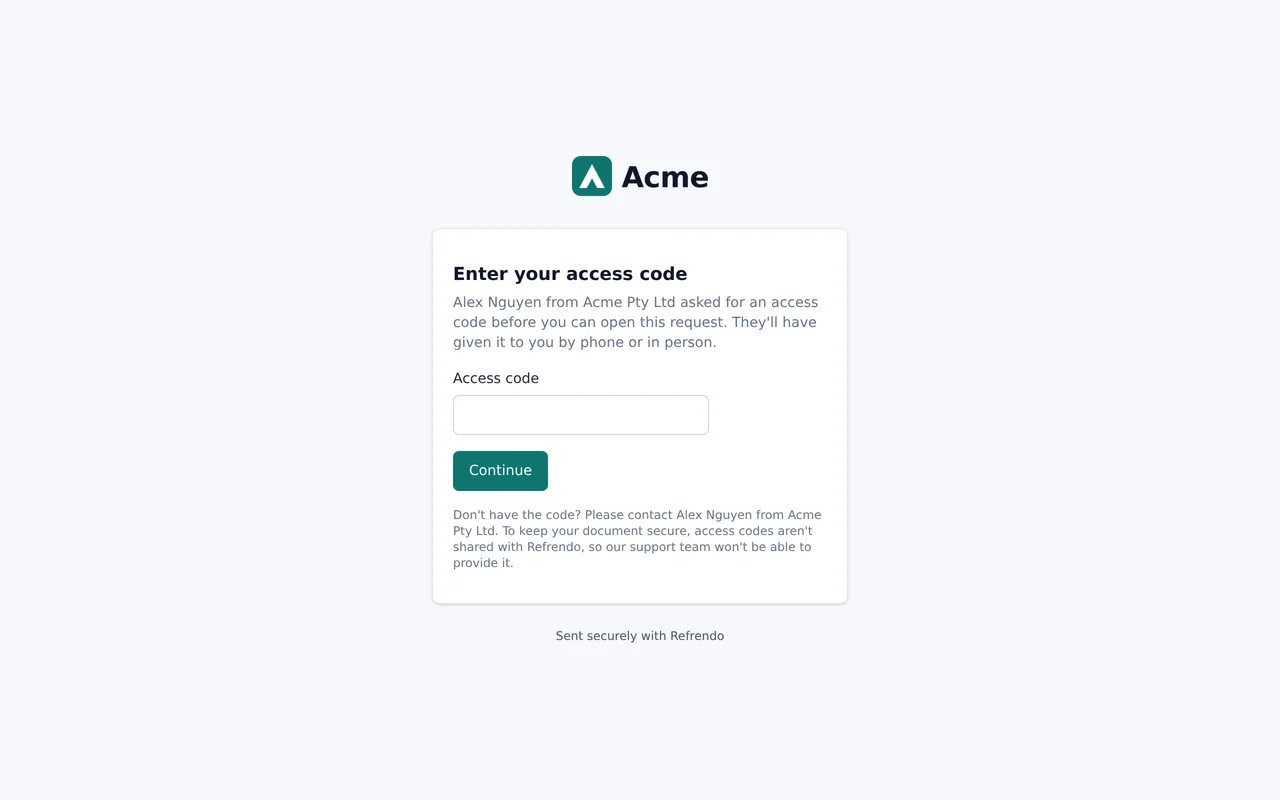
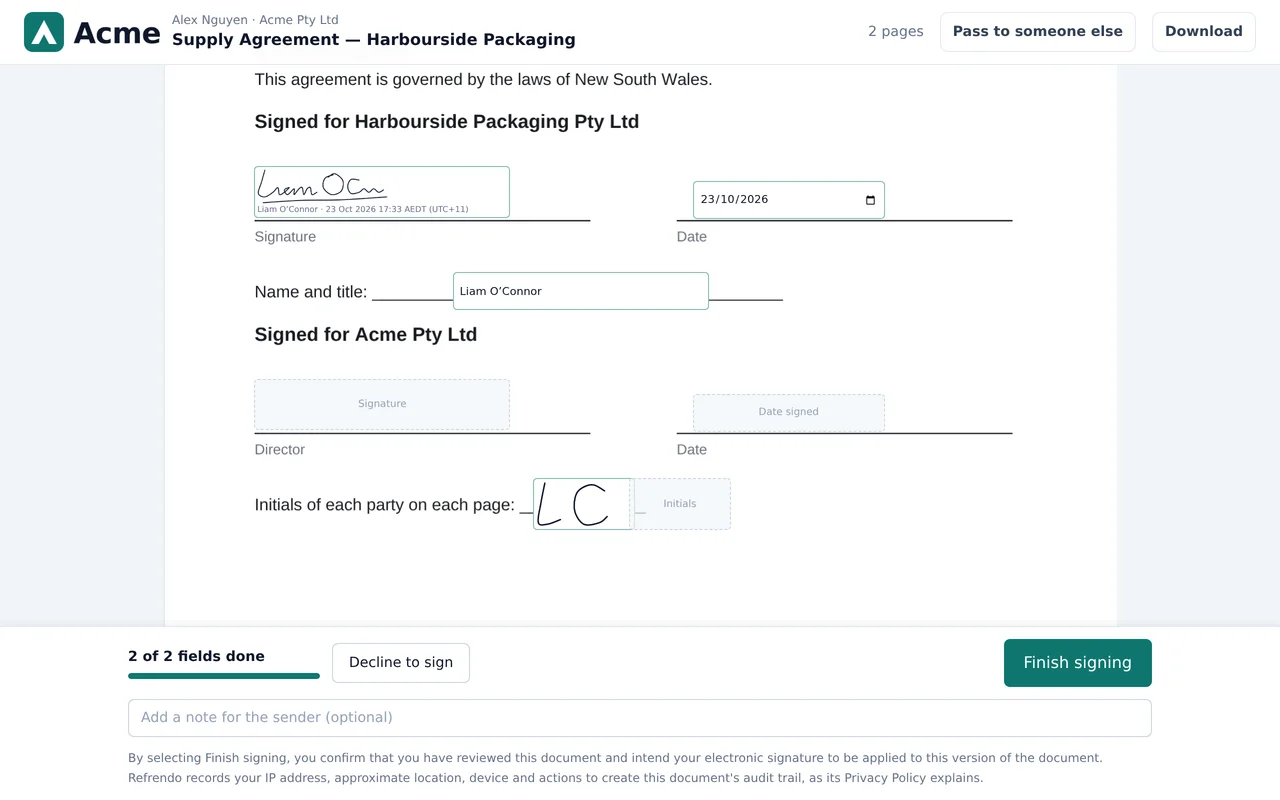
The supplier then reads your organisation’s short disclosure about electronic records, agrees to use them, and signs, with their initials on each page where you placed them. On Business and above, the signing page, the emails and the page where they collect their signed copy carry your logo and colour.
Who can sign for a company
Section 127 of the Corporations Act lets a company execute a document without a seal if it is signed by two directors, by a director and the company secretary, or by the sole director of a proprietary company. Different directors can use different methods, so one can sign on paper and the other electronically.
The reason to ask a supplier to sign that way is section 129(5). If a document appears to have been signed in line with section 127, you are entitled to assume it was properly executed by the company. That assumption isn’t available if you knew or suspected it was wrong.
A supplier’s account manager can also sign, under section 126, if the company has given them authority. That is common and often fine, but you take the person’s authority on trust. For an agreement that matters, ask for two directors, or a director and the secretary, and put both in the supplier’s step.
The same applies on your side. Your countersignature should come from someone who can sign for your company. If your director passes their turn to a colleague, make sure that colleague has the authority too.
Collect the supplier’s details as they sign
Place fields for the supplier to fill in as part of signing: their registered company name, ABN, address, the name and title of the person signing, and a contact phone number. The details land on the signed agreement exactly as the supplier entered them, and you don’t have to send a separate form.
Treat bank details differently. Refrendo confirms that the person who signed controls the email address the request went to, and, if you gave them an access code by phone, that they had it. It does not check identity documents, and it cannot tell you whether a supplier is genuine. Payment redirection scams depend on new bank details arriving in a message that looks right. Confirm any bank details by phone, on a number you already had, before the first payment.
Standard terms and small suppliers
If you send the same agreement to every supplier on a take-it-or-leave-it basis, it is probably a standard form contract. Since 9 November 2023, proposing, applying or relying on an unfair term in a standard form contract with a small business is prohibited under the Australian Consumer Law. For a company the maximum penalty is the greatest of $50 million, three times the benefit obtained, or 30% of adjusted turnover during the breach. A small business here means fewer than 100 employees or turnover under $10 million, which covers most Australian businesses.
Refrendo gets the agreement approved and signed, and leaves what it says to you. Have your terms checked before you use them across your supplier base.
Deeds
Some supplier documents are deeds rather than agreements, such as a deed of confidentiality or a guarantee. The rules for executing a deed are stricter than for an agreement. A company can execute one electronically under section 127 without a witness, but deeds signed by individuals, including sole traders, follow the law of their state, and some states still require a witness. Refrendo is made for agreements. For a deed, follow your lawyer’s advice on how it should be executed.
What ends up in the file
The signed agreement, and a completion certificate listing everyone who approved and signed, what they did, when, how they were identified, and fingerprints of the document before and after signing. Every step is chained to the one before it, so a later edit is detectable. Keep them for the whole term of the agreement and well beyond it. In most states a claim for breach of contract can be brought up to six years after the breach, which may be long after the signing.
Once the agreement is signed, the purchase orders under it can follow the same pattern: see purchase order approvals.
This is general information, not legal advice. Contract and execution rules depend on the document and the parties. Check with your lawyer before you change how your business executes agreements.