Your club can probably have this free
If the group is not-for-profit, run by volunteers and under $500,000 a year, apply to the community program and we will set you up free. A person reads every application and we check the ABN or the state register, so it takes a few days rather than a moment, but no card is needed and there is no trial period. The rest of this page is what you would be getting.
Who can sign for an association
An incorporated association is not a Corporations Act company. It gets its legal personality from registration under your state or territory’s associations incorporation legislation, which means the execution shortcuts in section 127 of the Corporations Act, the ones companies rely on, do not apply to you.
Your authority to sign comes from the association’s own rules or constitution instead. Most model rules say that documents are signed by two committee members, sometimes with the common seal. So the first step is not choosing a signing tool: it is reading your rules and confirming who is authorised to sign the thing, and that the association can enter into it at all.
Electronic signing rests on your state’s Act
The Electronic Transactions Act in your state or territory is what makes an electronic signature count. The test is the familiar one: the method identifies the person, shows they intended to sign, is reliable for the purpose, and the other party consented to signing electronically.
Good practice is to have the committee pass a resolution authorising electronic signing before you start, and to draft it broadly rather than for one document. A court has held that a resolution authorising electronic signatures was too narrow to cover the document a lender relied on, and that the people whose signatures appeared had no real involvement in applying them. The lesson is worth taking: each signatory should apply their own signature themselves, through something that records how they did it.
Conflict of interest declarations, on the record
Disclosing a conflict of interest is a legal obligation, and it comes with a written record. In NSW, section 31 of the Associations Incorporation Act 2009 requires a committee member with a direct or indirect interest in a matter to disclose the nature of that interest as soon as possible, with a penalty attached. A standing disclosure can cover an ongoing relationship with a particular company or person. Particulars have to be recorded in a book kept for the purpose, open to inspection by any member. Unless the committee determines otherwise, the conflicted member must not be present while the matter is deliberated and must not vote on it. Other states have their own versions of this, worded differently.
A signed, dated declaration from each committee member, with a certificate showing when each one signed, gives the committee a record it can produce if asked. Send it annually, and again whenever something changes.
The documents a club sends
- Committee resolutions passed between meetings, signed by everyone who has to sign them.
- Conflict of interest declarations from every committee member, once a year.
- Volunteer and coach agreements, codes of conduct, and the behaviour policies that parents have to acknowledge.
- Membership forms and renewals, where every member signs and none of them is charged.
- Venue hire, sponsorship and supplier agreements, usually needing two committee signatures.
- Grant applications and acquittals, where the funder wants a signature from an office holder.
Membership forms from a link
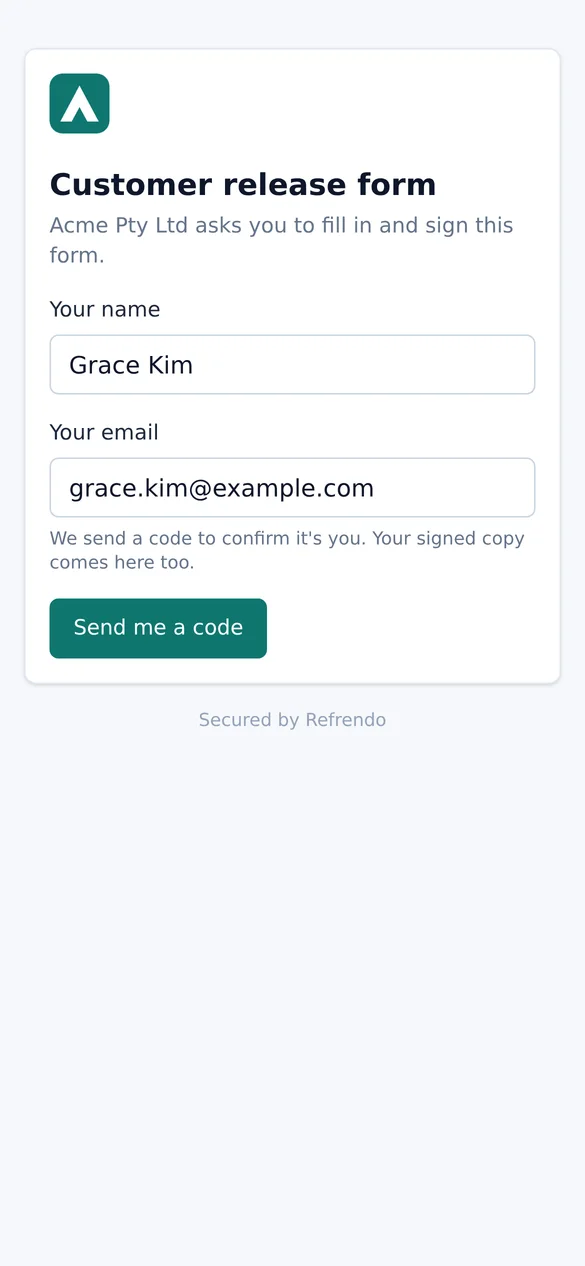
A membership form doesn’t have to be sent to each person. On Business and above, turn the form’s template into a public form link and put it on the club’s website, in the newsletter, or on a QR code at the registration table. The new member enters their name and email, proves the email with a one-time code, fills in their details and signs. The form then goes through the template’s steps, such as the registrar’s approval, and the member is emailed their signed copy.
A check before any code is emailed, and a daily limit on each link, keep the link from being misused, and the committee member who switched it on is told if it reaches its limit.
Handovers survive the AGM
Committees turn over every year, and the club’s documents usually live in the outgoing secretary’s personal email. Everything sent through Refrendo sits in the association’s workspace instead, and roles can be handed to the incoming committee without anything being forwarded, re-sent or lost. The people who signed keep their own copies too: when the last signature is in, everyone is emailed a link to download the completed PDF and certificate.
Where to be careful
Deeds are the main one. The rules for executing a deed electronically vary between states and between entity types, and an association does not get the benefit of the company provisions. Working with children checks are a state screening process, not a signature. And anything your rules say must be done at a properly constituted meeting still has to be done at one.
This is general information, not legal advice. Associations legislation differs in every state and territory. Check your own rules and your state regulator before you change how the committee signs things.